[This Content was updated on April 17, 2026]
Since the publication of this analysis, the initial divergence in Latin America’s responses has become more structurally defined, particularly as domestic political cycles and fiscal constraints begin to shape each country’s room for maneuver. In Brazil, the government has maintained a pragmatic balancing act, avoiding overt alignment while signaling openness to selective economic engagement—especially in sectors tied to energy transition and industrial policy. Mexico, by contrast, has doubled down on its structural integration with the U.S. economy, reinforcing nearshoring dynamics but also exposing itself more directly to shifts in U.S. political priorities. Colombia continues to navigate a more complex path, with internal political fragmentation and economic pressures limiting its ability to articulate a cohesive external strategy.
At the same time, the broader regional context has evolved, with increasing evidence that private sector actors—particularly in energy, infrastructure, and healthcare—are recalibrating their investment and advocacy strategies in response to this differentiated landscape. Rather than a unified “Latin American response,” what is emerging is a more fragmented but opportunity-rich environment, where policy signals are highly country-specific and often tied to short-term political incentives. For international companies, this reinforces the importance of granular, in-market intelligence and tailored engagement strategies, as the interplay between domestic politics and global geopolitical shifts continues to redefine how governments position themselves vis-à-vis major powers.
[This Content was updated on April 16, 2026]
With the benefit of hindsight, the region’s responses to President Trump’s second term look less confrontational and more adaptive than many initially expected. In Colombia, President Petro has largely avoided escalation with Washington, managing disagreements on drug policy through quiet negotiation. In Mexico, President Sheinbaum has prioritized continuity, and, on key issues such as migration, security, and trade, she has ultimately aligned with U.S. priorities. In Brazil, President Lula has kept more political distance, leveraging climate leadership and ties with China after COP30 to sustain a narrative of autonomy, while still containing open frictions with the Trump administration.
[Original article]
Donald Trump’s second term as President of the United States has already had a significant impact on U.S.-Latin America relations. In his first days in office, President Trump signed a series of Executive Orders that reflect his “America First” agenda, including stricter immigration policies, trade and tariff barriers, and cuts to foreign aid. His actions, such as declaring a national emergency at the U.S.-Mexico border and threatening tariffs on Mexico and Canada, set an immediately confrontational tone with Latin American countries.
Mexico, Brazil and Colombia have taken markedly different approaches to this situation. While Mexico has responded pragmatically, with President Claudia Sheinbaum focusing on strategic policy measures instead of direct confrontation, Colombia, on the other hand, has been more confrontational. President Gustavo Petro initially blocked deportation flights, prompting sanctions from Trump. However, a diplomatic resolution was quickly reached, though tensions remain over issues like drug trafficking and U.S. foreign aid cuts. Colombia’s dependence on the U.S. complicates its ability to move away from Washington.
Brazil faces a different dynamic due to its economic strength and geopolitical position. While President Luiz Inácio Lula da Silva’s policies differ greatly from Trump’s, Brazil’s economic independence allows for a more flexible approach. Brazil may face disruptions in agricultural exports and growing geopolitical tensions over China’s influence, but Lula aims to maintain stable ties with the U.S., despite ideological differences.
Mexico: A Pragmatic Approach Amidst Trump’s New Policies
Trump’s first executive actions targeted Mexico, addressing key issues of trade, migration, and security—areas that are deeply intertwined and pose significant challenges for President Claudia Sheinbaum’s administration. These developments will test her diplomatic and governance skills.
Despite Trump’s rhetoric, Sheinbaum has opted for a pragmatic response. She emphasized that Mexico would react based on concrete policy actions rather than political statements, noting: “At this moment, there are no tariff impositions by the U.S. government, so there is no need to get ahead of ourselves.”
Trump’s National Emergency Declaration at the U.S.-Mexico border, which reinstates the “Remain in Mexico” policy and authorizes the deployment of 1,500 additional U.S. military personnel, has sparked concern. In response, Mexico launched the “Mexico Embraces You” program, designed to support deported Mexican migrants by offering social services and reintegration assistance.
Trump’s designation of Mexican cartels as Foreign Terrorist Organizations (FTOs) challenges Mexico’s security strategy, “hugs, not bullets,” championed by former President Andrés Manuel López Obrador. However, Sheinbaum seems to be moving towards a more assertive approach, as demonstrated by Mexico’s record-breaking fentanyl seizures.
Additionally, Trump’s threat to impose tariffs on Mexican imports, scheduled to take effect on February 1, adds uncertainty to U.S.-Mexico trade. However, the Mexican government acted swiftly, introducing fiscal incentives to attract investment and bolster innovation within 24 hours of Trump’s inauguration.
In summary, the U.S.-Mexico relationship under Trump is poised to be turbulent. Yet Sheinbaum’s strategic, non-confrontational approach may help safeguard Mexico’s economic and diplomatic interests.
Colombia: Diplomatic Struggles and a Battle of Wills
On January 26, President Gustavo Petro blocked a U.S. military flight carrying deportees, criticizing the inhumane conditions of the deportations.
Trump retaliated with sanctions, including emergency tariffs of 25% on Colombian imports, a travel ban on government officials, and enhanced border inspections. Petro responded via social media, asserting that Colombia would impose tariffs on U.S. goods and was unafraid of the blockade. However, a swift diplomatic resolution followed, with Colombia agreeing to accept the deportation flights in exchange for the U.S. retracting some of the sanctions.
This exchange illustrates how Colombia’s ideological differences with Trump will influence its foreign relations for the duration of Petro’s term. While Colombia’s economic dependence on the U.S. limits its maneuvering room, it will seek to diversify its trade partnerships, particularly with China.
After the U.S. froze foreign development assistance, impacting transitional justice programs in Colombia, Petro pledged to cover the funds from the national budget. A major concern for the future of U.S.-Colombia relations is whether the U.S. will certify Colombia’s progress in the fight against drug trafficking, as failure to do so could jeopardize vital resources.
With electoral campaigns for Colombia’s 2026 presidential election already underway, political opposition is mounting, urging the government to adopt a more pragmatic approach in handling relations with the U.S.
Brazil: Shaping Regional Dynamics Under Trump’s Second Term
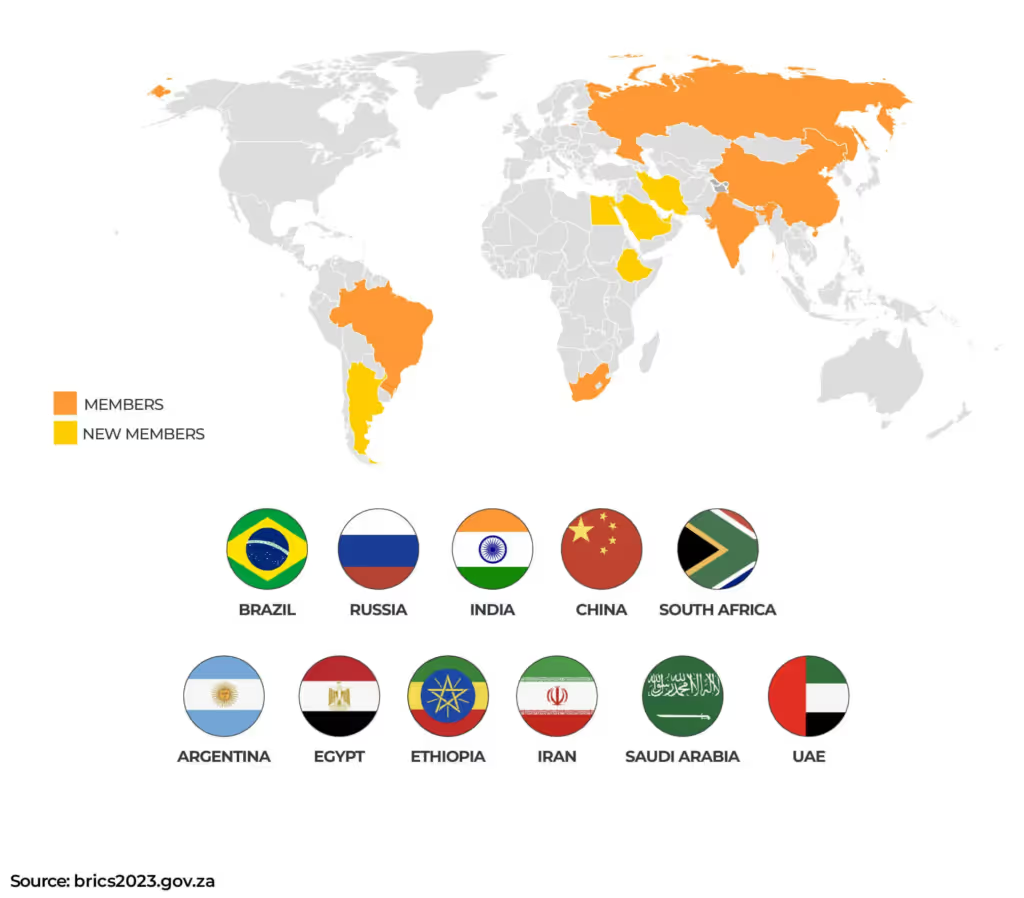
Brazil presents a different case. While President Luiz Inácio Lula da Silva’s policies diverge sharply from Trump’s, Brazil’s economic independence and its role as Latin America’s largest economy enable it to engage with the U.S. on more balanced terms.
One point of contention will be China’s growing influence in Latin America. Lula has advocated for expanding the BRICS bloc, while Trump has warned against de-dollarizing the global economy. Since the 2024 election, Trump has threatened to impose 100% tariffs on BRICS members if they create a shared currency, to which Brazil has promised retaliatory measures.
Brazil’s agricultural exports, particularly soybeans and beef, could be threatened by Trump’s protectionist policies, prompting Brazil to consider diversifying its trading partners.
Trump’s second term could also undermine global environmental initiatives, particularly those involving Brazil, which will host COP30 in 2025. Brazil’s critical role in protecting the Amazon and meeting climate goals may be hindered by a U.S. administration that is less engaged in global climate agreements.
Moreover, concerns are mounting that a Trump presidency could indirectly fuel far-right movements in Brazil, particularly through digital platforms that U.S. tech giants control. This relationship could echo the ties Trump had with former Brazilian President Jair Bolsonaro, strengthening conservative factions in Brazil.
Despite ideological differences, Lula’s pragmatic approach to U.S.-Brazil relations suggests a focus on maintaining stable and functional bilateral ties, although the U.S.’s transactional foreign policy could push Brazil toward closer ties with other global powers.
How Latin America is Adjusting to Trump’s Second Term
Trump’s hardline policies are already fraying U.S.-Latin America relations. While Mexico and Colombia have limited room for maneuver due to their economic dependence on the U.S., Brazil enjoys greater flexibility, using its economic power to chart an independent course.
Countries in the region, especially those ideologically at odds with Trump, may seek to diversify their partnerships, strengthening ties with China to reduce dependency on the U.S. At the same time, Trump’s rhetoric framing Latin America as a source of migration and crime could push these nations further toward alternative partners to bolster their geopolitical standing.
Ultimately, Latin American leaders are likely to adopt more pragmatic strategies in dealing with the U.S., as strategic autonomy from Trump’s volatile foreign policy is complicated by the unpredictable nature of his second term.
Conclusion
Trump’s second term is straining U.S.–Latin America relations, forcing countries to balance pragmatism with sovereignty. While Mexico, Colombia, and Brazil respond in different ways, all are reassessing their foreign policy strategies—many looking to diversify partnerships and reduce reliance on an increasingly unpredictable United States.