

The COVID-19 pandemic has changed the way we understand our health and has made us aware that self-care is an important part of maintaining and restoring it. Now more than ever people are aware that access to medical advice is not the only determinant of their health status and that there is a lot they can do to improve their quality of life.
A survey conducted by the Latin-American Association of Responsible Self-Care (ILAR) in 2021 found that more than half of Latin Americans (56%) felt the need to reduce or suspend their visits to the doctor. The study also found that 90% of Latin Americans searched for information about medicines online and 94% expressed that they would like to have more reliable sources available.[1] This renewed interest in learning more about our own health and the medications we can take in case we face symptoms we can manage at home creates favorable conditions to develop health literacy initiatives.
This is especially relevant since, according to estimates from the World Health by 2030 there will be a shortage of approximately 18 million health professionals worldwide. [2] Since health systems will be facing significant pressures, self-care including responsible and informed self-medication seem like a viable option to improve health outcomes in Latin America.
The COVID-19 pandemic has boosted the use of digital technologies for different purposes. In the 2022 world it is common to visit restaurants and consult their menu scanning a QR code with our cellphones. So, why not use this same technology to learn more about our medications? Why not replace those unappealing paper leaflets for a video that plays on our cellphone and explains the indications to safely use an OTC product in a dynamic and attention-grabbing way?
There is a worldwide tendency to implement e-labeling schemes, but regulations are moving at different speeds.[3] Since Latin Americans are increasingly interested in their own health and are using digital technologies to access information more than ever before, there is a fertile ground to position e-labeling as a health literacy tool that could facilitate the deployment of product information while improving patient understanding on how to safely use OTC products.
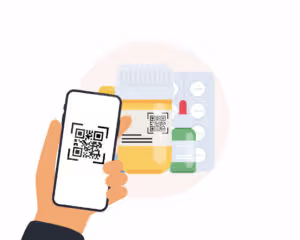
According to the International Federation of Pharmaceutical Manufacturers & Associations (IFPMA) e-labeling could not only contribute to protect patient safety and promote better understanding between patients and healthcare providers, but it could also improve supply chain resilience and efficiency since it is a more flexible way of sharing relevant product information.
E-labeling for OTC products seems like a good idea for manufacturers, distributors, retailers, healthcare professionals, and most importantly, for consumers. Therefore, it is time for national regulatory authorities across the Latin American region to rethink e-labeling as useful healthcare literacy tool and it is time for us to get them thinking on how to adjust their regulatory frameworks to make this a reality.
__________________________
[1] The survey was conducted in Argentina, Brazil, Colombia, Mexico, Chile, Peru, Panamá, Guatemala and Costa Rica. See: ILAR, Impacto COVID-19 en los hábitos de salud, uso y compra de medicamentos de venta libre y experiencia con servicios digitales en América Latina, 2021
[2] World Health Organization (WHO), WHO guideline on self-care interventions for health and well-being, 2022 revision, page 3. Available at: https://www.who.int/es/publications/i/item/9789240052239
[3] IFPMA, IFPMA position paper on Improving Patient Safety and Health Systems Resilience Through the Use of Electronic Labeling. Available at: https://www.ifpma.org/wp-content/uploads/2022/02/IFPMA_Position-paper_Electronic-labeling.pdf
Conclusion
E-labeling for OTC products offers clear benefits for patients, healthcare systems, and the industry. Latin American regulators should adapt their frameworks to embrace this digital shift and strengthen health literacy across the region.


