
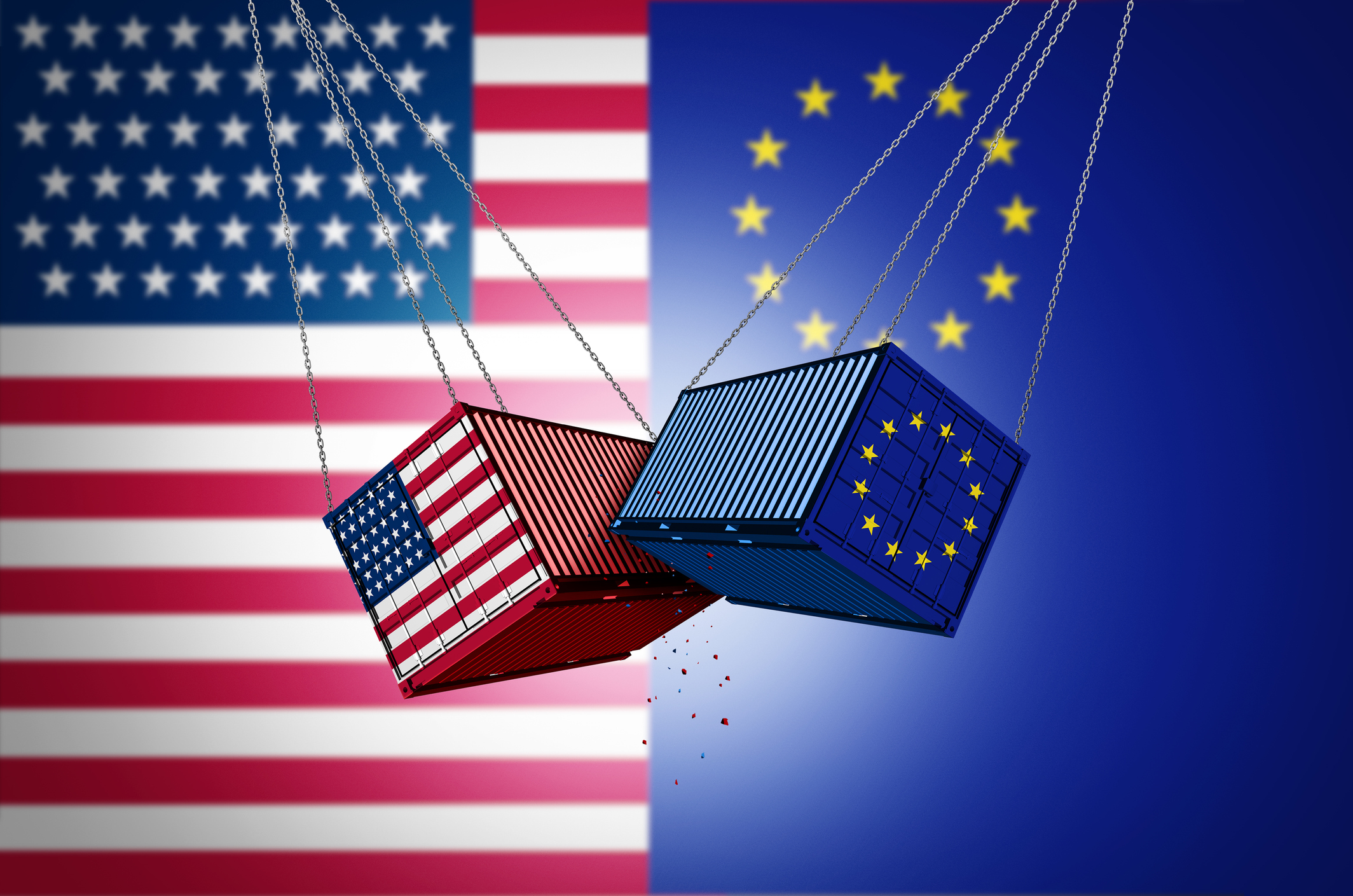
President Donald Trump’s sweeping trade offensive against Europe — culminating in a deal imposing a 15% tariff on most EU exports as of August 2025 — marks asignificant rift in transatlantic relations. Announced at Trump’s Turnberry golf resort on July 27, the pact followed months of threats (he initially demanded 30%) and tough negotiations with European Commission President Ursulavon der Leyen. In return for avoiding steeper tariffs, the EU agreed to massive concessions: $750 billion in U.S. energy purchases over three years and $600 billion in new investments in the U.S. European steel and aluminum will still face a 50% tariff, with quotas forthcoming, and the EU pledged not to retaliate.
This move coincides with Trump ramping up pressure on NATO allies, whom he accuses of “freeriding” on U.S. defense, and suggesting that protection under Article 5 might not be guaranteed if defense spending obligations aren't met. Together, these trade and security moves usher in a new era of transactional U.S. policy— one forcing CEE countries to navigate immediate economic upheaval and makedifficult strategic choices under pressure.
Trump’s tariff campaign goes beyond addressing trade deficits — it serves as a political instrument to steer allies’ behavior and reinforce U.S. dominance. In Brazil, tariffs were used to shield an ideological partner; in Europe, the trade offensive was paired with pressure on defense commitments. By escalatingeconomic leverage, Trump is pushing the EU — especially its eastern members —to align more closely with Washington’s strategic agenda.
The 15% tariff was framed as correcting Europe’s trade surplus, but the attached energy and arms deals sent a clearer message: U.S. support comes at a price. The EU agreedto buy $250 billion per year in American energy through 2027 and pledged “hundreds of billions” for U.S. defense goods. The pact is designed to edge Russia out of its former energy markets and cement Washington as Europe’s top security provider. Moscow called the deal “anti-Russian,” noting the U.S. has seized the leverage it once held.
For CEE countries that border Russia or historically relied on its fuel, the message isdouble-edged: the U.S. will provide gas and weapons — but at high cost, and with expectations. The pact has also stirred divisions in Europe. France slammed the deal as a capitulation and urged retaliation. But beyond Hungary’s Viktor Orbán, who harshly criticized the agreement and described it as a diplomatic defeat, no leader publicly backed that stance. Most CEE governments, though uneasy, refrained from criticism — presumably because they recognize how deeply they rely on American security guarantees and relationships.
Economic Fallout in CEE
The economic fallout is significant, especially in CEE, where economies are highly export-driven and integrated into Western European supply chains. That means U.S. tariffs on Germany and France ripple through to Prague, Bratislava, and Warsaw. Automotive production is especially exposed. CEE factories supply partsand assemble vehicles for brands like Volkswagen, many destined for U.S.dealerships. The new 15% tariff — though lower than the threatened 30% — still undermines competitiveness. A Slovak-built SUV now costs more in the U.S.,which could lead to lower demand and even production cuts. Oxford Economics warns that CEE manufacturers — especially in the auto sector — are among the hardest hit by Trump’s trade moves due to their deep links with German industry.
Beyond autos, steel, aluminum, copper products, and machinery face similar pressures. While some tariffs may be replaced by quotas, the uncertainty is already deterring investment. Meanwhile, Chinese manufacturers are well-positioned to capturemarket share, both in the U.S. and globally. Analysts anticipate “stiffer competition from China” as European firms face rising costs and tradeuncertainty.
Multinationals are now looking toward the U.S. — not CEE — for new factory locations. As partof the deal, EU companies announced $600 billion in new U.S. investment, suggesting that capital may shift westward. That would be a longer-term blow to CEE’s manufacturing sector, which has been a pillar of its economic rise.
Still, while the immediate outlook is challenging, the disruptions are already prompting deeper reflection across CEE. Governments and firms are not withdrawing from global markets but beginning to reposition — diversifying supply chains, exploring new export partnerships, and reinforcing domestic resilience. In Poland, for example, government estimates suggest the country could lose over $2 billion due to U.S. tariffs, prompting businesses to accelerate efforts to build new market linkages. Meanwhile, some manufacturers in Slovakia and Czechia are reportedly shifting parts of their production to countries like Mexico to maintain tariff-free access to the U.S. — a clear sign of strategic realignmen trather than retreat.
Political Fallout and Strategic Lessons for CEE
Domestically, the Trump shock is deepening divides. In Poland, Tusk’s pro-EU government faces criticism from populists who argue the country should negotiate directly with Trump. They claim Poland could secure exemptions or better terms by prioritizing Washington over Brussels. Similar debates are playing out in Czechia and Slovakia. Hungary’s Orbán, while generally Trump-friendly, objected to the deal — a rare alignment with France, as some speculate, likely driven byhis ties to Moscow – seeing the deal as too anti-Russia – or simply by a desire for EU concessions to Hungary in exchange for not vetoing the deal.
Either way, unity n the EU is being tested, and internal divisions within CEE countries are sharpening. Pro-Western factions argue that Europe must stand together and become more self-reliant in response to an unreliable ally, while populist and business voices contend that a pragmatic accommodation with Trump (even if it undermines EU cohesion) could save their industries from ruin.
Businesses, meanwhile, are adapting fast. The age of predictable, tariff-free trade isclearly over. Companies are reassessing supply chains, eyeing U.S. relocation, and seeking new markets. Defense and cybersecurity firms are booming, while others are trying to move up the value chain or find new buyers in Asia and the Middle East. The early signs suggest that some CEE industries are learning to navigate in the face of systemic pressure.
Conclusion
Trump’s confrontational approach to trade and alliances has forced Central and Eastern Europe to confront a new reality. The post–Cold War era of stable transatlantic ties is fading. In its place is a world where economic and security cooperation are subject to constant renegotiation — and leverage. And CEE countries aren’t standing still. They’re rearming, rebuilding alliances, and rethinking their economies. Transitions of this scale won’t happen overnight. But the direction of travel is clear: greater strategic flexibility, regional resilience, and a broader understanding of global opportunity.


