
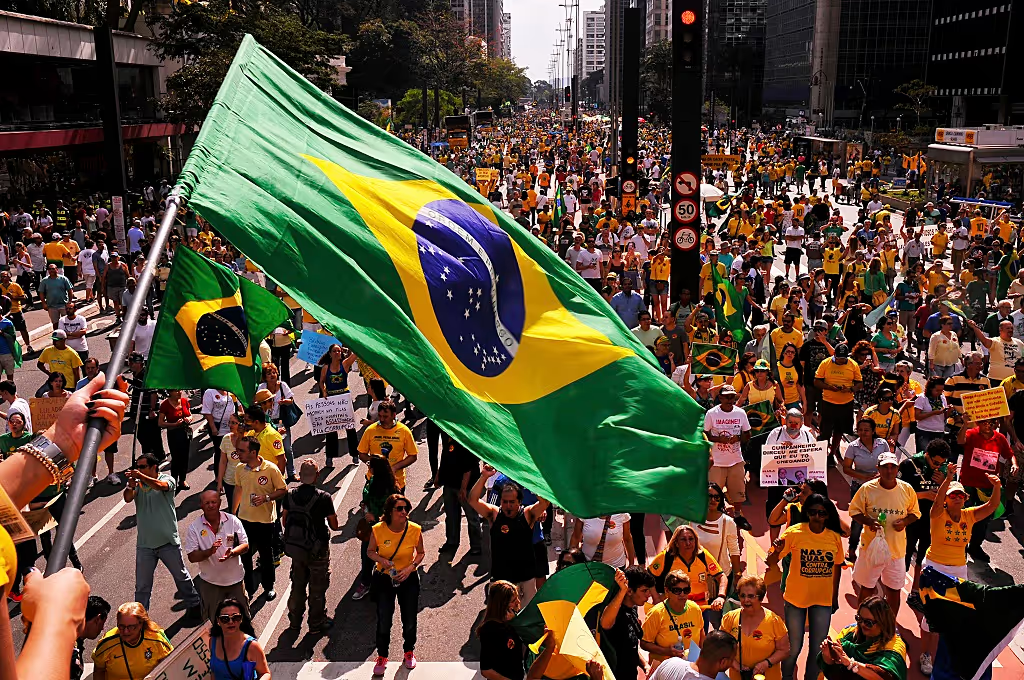
Luiz Inácio Lula da Silva was formally elected for a four-year term as President of Brazil, as he won yesterday’s second round of Brazilian general elections. Lula held 50.9% of the votes (60,3 million), against Jair Messias Bolsonaro, with 49.1% (58,2 million). His election occurred twelve years after he left office in 2010, after serving as President for two terms in the 2000s.
Elected by a margin of just over 2 million votes, in his victory speech, Lula highlighted his objective of unifying Brazil. “It is necessary to resume the dialogue with the Legislative and the Judiciary, without attempts to exorbit, intervene, or control”, said the president-elect. Governability will therefore be one of the main challenges for the PT and its allies where Brazil is a considerably more conservative country that it was 20 years ago when Lula was President.
- There should be no Legislative paralysis: Lula will face stiff opposition in Congress, but he is able to form a parliamentary base that guarantees him the necessary support to follow his agenda.
- The government’s support base in the Chamber of Deputies will be approximately 144 deputies – 28% out of the 513 seats – when added to the parties’ benches that declare support for the president elected in the second round. Approximately 194 elected deputies are independent.
- Other parties that didn’t enforce Lula’s candidacy have signaled that they may support, in whole or in part, the elected government – which could bring the total to 212 parliamentarians (41%).
- Lula will begin his term with an allied base of 16 senators (19%). The president will have to win votes from approximately 40 independent senators, compared to 25 for the opposition (31%).
- The elected government will take advantage of the political capital achieved during the elections to pass the Tax Reform. The vice president-elect, Geraldo Alckmin, says that the government could approve it in the first half of 2023 – a timeline pointed out as optimistic by analysts.
How will the upcoming presidential elections impact public healthcare funding in Brazil?
Impact on Crypto
Like Jair Bolsonaro, Lula did not define any government plan related to the Brazilian cryptoeconomy. However, there are rumors that Henrique Meirelles, former president of the Central Bank of Brazil and former Minister of Finance, may receive an invitation from the president-elect to join the government.
Two months ago, Meirelles became Binance’s Global Advisor. The former minister’s participation in the government would be Lula’s nod to the market, which fears that Lula’s Workers’ Party unorthodox economic policies will destabilize Brazil’s fragile fiscal system.
However, in general, we should not see many significant changes in the country’s crypto landscape, apart from the possible approval of the cryptocurrency regulation bill (PL 4401/2021), which has already been approved by the Federal Senate and awaits a vote in the Chamber of Deputies since April.
Impact on Infrastructure
In his victory speech, the president-elect highlighted that he intends to resume programs from his first two terms (2003-2010), such as Minha Casa Minha Vida and Luz para Todos. However, the focus of the new government will be the New Growth Acceleration Program (PAC) which will significantly expand public investment in infrastructure in Brazil.
According to the document “Letter to Brazil of Tomorrow”, a set of proposals presented by Lula’s campaign, the main areas of action of PAC will be housing, transport and urban mobility, energy and sanitation. These proposals do not resonate with all private investors. There is a large group that would prefer investments in railways, ports, and airports and some of these are already in the pipeline to be privatized during the Bolsonaro government.
Federal public banks (Caixa Econômica, Banco do Brasil and BNDES) must finance the works. The Brazilian press are discussing names for the new President of BNDES, the Brazilian investment bank. Gabriel Galípolo, a 39-year-old economist and former CEO of Banco Factor, is the front-runner.
“The first thing I’m going to do, in the first week of January, is to bring together the 27 governors to discuss each state’s priorities in infrastructure works,” said the president-elect. There are still no clear recommendations for the Infrastructure and Regional Development Ministries.
The first thing I’m going to do, in the first week of January, is to bring together the 27 governors to discuss each state’s priorities in infrastructure works,” said the president-elect.
Impact on Energy
One of the main promises of Lula’s campaign is to continue Petrobras’ investments. During Bolsonaro’s government, the company became a major investment payer, with profits boosted by the focus on high-yield assets in the pre-salt layer. Lula is thinking of Senator Jean Paul Prates, from Workers Party of Rio Grande do Norte State (PT-RN) to steer the company during his term as president. The senator held more than 100 meetings with investors during the electoral campaign to highlight Mr. Lula’s plans for Petrobras and to calm down shareholders.
The president-elect is likely to focus on the construction of plants for refining, taking advantage of the pre-salt layer, and realigning the prices of derivatives in the domestic market. Fuel parity with the international market has been in effect in Brazil since 2016. According to the document “Letter to Brazil of Tomorrow”, a set of proposals presented by Lula’s campaign, one of the next government priorities is to initiate the ecological energy transition. “It is essential to guarantee the country’s energy sovereignty and security, with an expansion of the energy supply, deepening the diversification of the matrix, with the expansion of clean and renewable sources at prices compatible with the Brazilian reality”, states the document.
One of the main exponents of Lula’s campaign was former Environment Minister and internationally recognized environmentalist Marina Silva. One of the former minister’s conditions to join the president-elect’s team was the integration of environmental and sustainability proposals to his government agenda.
The victorious candidate also stated that he will resume the country’s leading role in the fight against the climate crisis – one of the main achilles’ heels of the Bolsonaro administration before the international community. “In our government, we were able to reduce deforestation in the Amazon by 80%. Now, we are going to fight for zero deforestation”, said Lula. Another initiative that Lula’s government will promote is to increase investing in the two clean energy resources that are growing fast in the country: solar and wind power.
Conclusion
Lula faces a divided Congress but has enough political support to push forward key initiatives like tax reform and public infrastructure investment. His administration is expected to revamp social programs, expand clean energy, and strengthen Petrobras, while taking a more active role in environmental protection. Though challenges remain—especially with a conservative legislature and economic pressures—Lula’s government signals a shift back to more state-led development and stronger social policies, with an emphasis on sustainability and regional dialogue.


