
As 2022 draws to a close, the Speyside team would like to wish all our partners and friends the very best for the holiday season, and of course a prosperous and peaceful 2023.
As has become tradition at this time of year, our teams around the globe have summarised some of their thoughts on the outlook for the year ahead across global emerging markets. We hope you find this an enjoyable and useful read.
Global Outlook
The debate still rages:
The bulls point to inflation slowing, China opening, energy prices easing, and the US economy increasingly likely to have a soft landing.
The bears point to the commitment of central banks to bring down inflation, the prospect of a long war in Ukraine, tech and crypto shocks and uncertainty around China.
Much of this discussion centers (understandably) on North America and Western Europe, but from our EM vantage point, there are reasons for optimism.
- China is opening fast and appears on a one-way track, releasing huge pent-up demand domestically and easing supply chain pressures globally
- India is posting stronger than expected GDP numbers and the fundamentals look good, with the government poised to stimulate growth further ahead of 2024 elections
- Latin America is a mixed bag, but there are reasons for optimism in Mexico which is benefiting (like India) from from “friendshoring” and strong fundamentals
None of this is to doubt the IMF, World Bank, OECD and others who are forecasting a very difficult global outlook with a global growth rate of around 1.2% in 2023, on par with 2009, when the world was only beginning its emergence from the financial crisis.
However, opportunities do exist, and many of them sit within global emerging markets, especially in Asia and Latin America.
Central & Eastern Europe
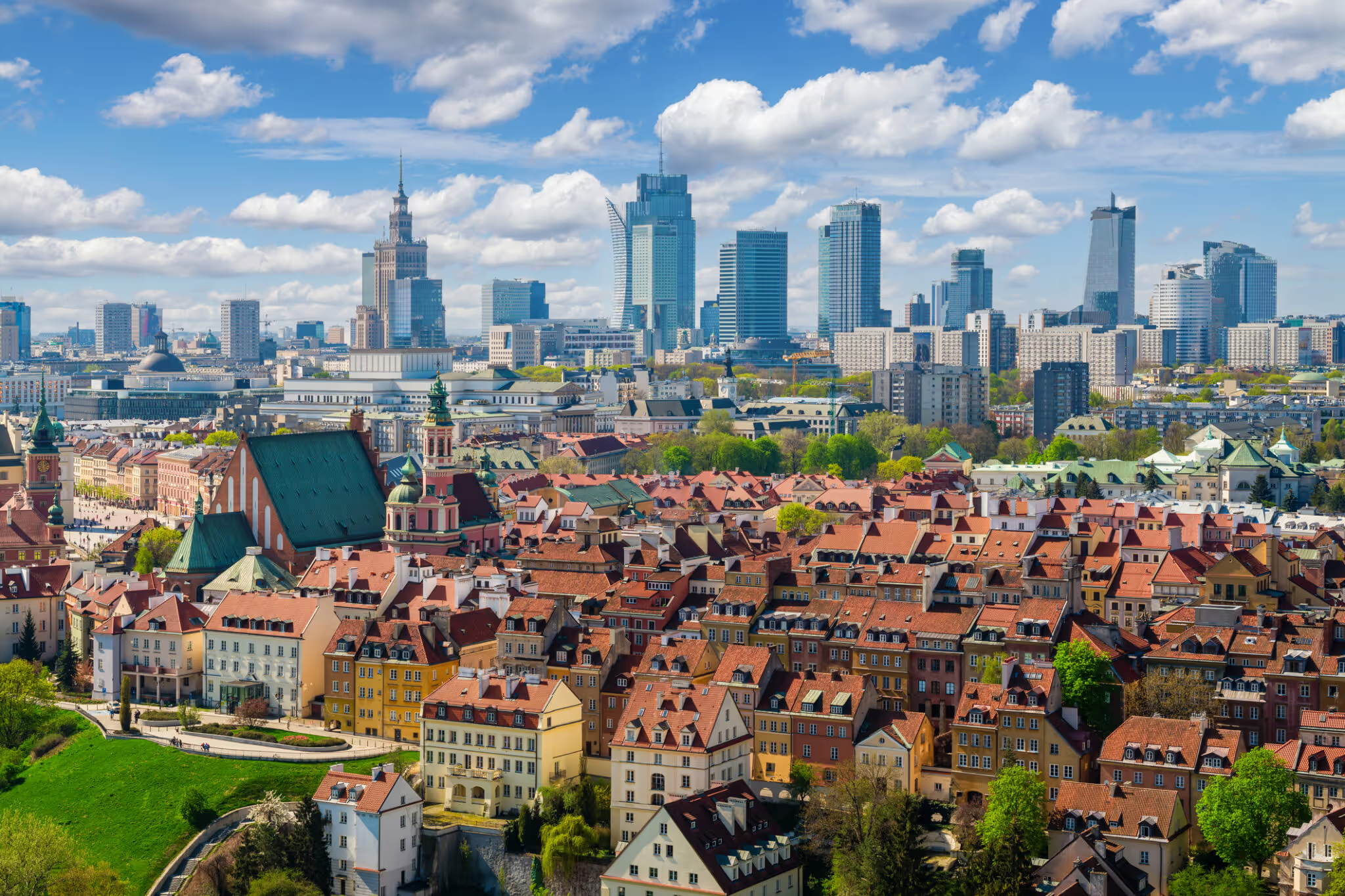
Poland: Heading Towards an Intense Election Year
In November 2023, Poland will hold elections for both chambers of parliament and begin an intense political campaign ahead of local elections (recently moved to spring 2024). Although there is little expectation of a radical change of power and politics in municipal elections, the result of the general elections is difficult to predict. Opposing parties have united against the ruling Law and Justice, gaining support in the polls and giving themselves a reasonable chance of taking power.
A change in government would mean significant changes in the structure of state institutions, as the opposition does not recognize some structures implemented by the current government but would mean broad continuity in economic policy. Relations with the EU would certainly improve. Disrupting this outlook, the ruling party is preparing to change electoral laws to stack the deck in their favour and are working to divide the opposition. Intensive Russian intelligence disinformation activities to destabilize the country in an election year (as was the case in previous years) cannot be ruled out with energy prices and inflation being the main flashpoints.
Hungary: Orbán Balances Financial Necessities with His Political Identity
2023 is expected to be one of the most difficult years of government for Prime Minister Viktor Orbán since he gained a parliamentary supermajority in 2010. Domestic support for the ruling Fidesz party remains steady, despite economic hardship, and the Hungarian political opposition is fragmented and lacks a viable unifying leader. Despite the domestic situation, government is under stress; though crucial EU Recovery funds have been approved at the last minute, a significant portion of the Cohesion Funds will remain contingent on the EU institutions’ close scrutiny of Hungarian anti-corruption and rule of law policies.
As Fidesz’s domestic strategy is predicated on blaming the deteriorating economic situation on common EU initiatives to aid Ukraine and Russian sanctions, Orbán will be taking a Janus-faced approach to policy, implementing institutional reforms as concessions to unlock funding while simultaneously taking measures that antagonise the EU, such as vetoing critical EU foreign policy related to the Ukraine conflict. Policy making is expected to remain extremely centralised, with only a few truly influential decision-makers, and major policies will likely focus on ad-hoc actions to mitigate negative macroeconomic trends (such as an EU record inflation of up to 18% for 2023) that harm living standards for Fidesz’s voter base.
Conclusion
The global outlook for 2023 remains uncertain, with inflation, geopolitical risks, and market instability shaping the macroeconomic context. However, emerging markets continue to present significant opportunities, particularly in regions adapting well to shifting trade and investment flows. In Central and Eastern Europe, Poland’s elections and Hungary’s strained EU relations will define their political landscapes. Countries able to maintain institutional stability while encouraging investment and managing inflation will be best positioned to weather global headwinds and emerge stronger.


