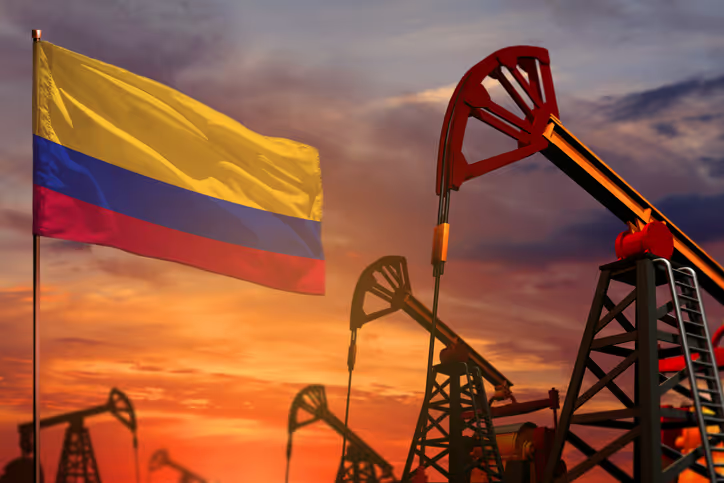
One of the key priorities articulated by Gustavo Petro during his presidential campaign and inaugural speech was the need for the country to transition towards clean and renewable energy sources.
At a macro-level, almost all would agree this is a welcome development, given the global fight against climate change and need for new and sustainable long-term approaches.
However, this transition represents a hugely complex challenge for Colombia, considering 56% of the country’s exports are coal and oil, contributing critical revenue to government.
This begs a series of critical questions, including:
- How to fill the fiscal gap left by the decrease in hydrocarbon exports?
- Will Colombia give up its energy security and self-sufficiency?
- Over what period will this transition take place?
- What will happen to Ecopetrol, one of the largest national employers?
No one has all the answers yet, with the Government still working on its roadmap for transition. However, details are starting to emerge on how the new government will approach the challenge.
New higher taxes on hydrocarbons and minerals
On his second day in office, the new president, through his Minister of Finance, submitted to Congress a bill proposing a tax reform. The document proposes a transformation in the taxation of the hydrocarbons and minerals sector, specifically in its external sales.
The bill establishes a new 10% tax on crude oil, coal, and gold exports, if the reference sales price set by the National Hydrocarbons Agency (ANH) is exceeded in any given month. The tax will also apply to the import coal (exports will continue to be exempted).
Another relevant point of the reform is that royalties paid by companies that develop mining and oil production activities in the country will not be deductible when determining the net taxable income for taxes. This is a significant change in the cost of doing business.
Restrictions on new exploration and development
During his campaign, Petro stated on multiple occasions that the country will not sign new contracts for oil exploration but that it will respect existing agreements. In a recent radio interview with Blu Radio the new Minister of Energy, Irene Vélez, confirmed that this promise will be kept.
Likewise, the Ministry of Environment and the Ministry of Mines filed before Congress a bill that proposes the prohibition of fracking in Colombia. This would close the door to unconventional oil and gas exploration in Colombia.
Many stakeholders are concerned about how sustainable these policies are, considering that current proven oil reserves will last only 6.3 more years and proven gas reserves up to 8 years, according to the National Hydrocarbons Agency.
A long road to travel
The new government plans to create a research center for renewable energies, which will train Colombians to create new local ‘export quality’ technologies to make the country a global player. This may help in the long-term but is unlikely to address the short and medium-term issue.
That said, Antonio Hill, advisor to the Natural Resource Governance Institute on energy transition, stated that the fiscal gap created by not exporting fossil fuels will occur sooner or later. If the country waits until the market for fossil fuels withers it will suffer a disorderly transition. If a roadmap is laid out now, the path will be clearer according to Mr. Hill.
President Petro says a team is in place to start the necessary work, but Colombia has a long road to travel. Currently, according to data from the Colombian Chamber of Energy, less than 3% of the country’s energy comes from non-conventional renewable sources. How the government decides to drive change will have a huge impact for all Colombians in the years ahead.
At Speyside we provide ad hoc insight reports for our clients on key economic, political and regulatory issues for key industries across emerging markets.
Conclusion
While the long-term goal of energy transition is necessary and ambitious, Colombia must carefully balance environmental goals with economic realities. Clear policy planning and gradual implementation will be critical to ensuring a just and sustainable transition.