
All posts
Published
October 30, 2025

Four trends in the energy sector that will shape LATAM in 2024

Latin America is set to lead the green economy in 2024, driven by renewables, biofuels, hydrogen, and critical minerals, with rising public-private investment. Speyside expertise helps leaders navigate corporate affairs in this high-growth market.

Latin America is set to lead the green economy in 2024, driven by renewables, biofuels, hydrogen, and critical minerals, with rising public-private investment. Speyside expertise helps leaders navigate corporate affairs in this high-growth market.

In 2024, Latin America will play a vital role in the world’s new green economy. Its geography and abundant natural resources, according to economic predictions, could make it a global  leader in renewable energy by 2030.

This vast region that covers Mexico, Central and South America has enormous potential to  develop and export advanced biofuels and low-emission hydrogen. Brazil, the green giant, leads the market with more than 86% of its electricity production coming from renewable sources, and smaller countries such as Panama and Costa Rica, who use almost 100% renewable energy to generate electricity.

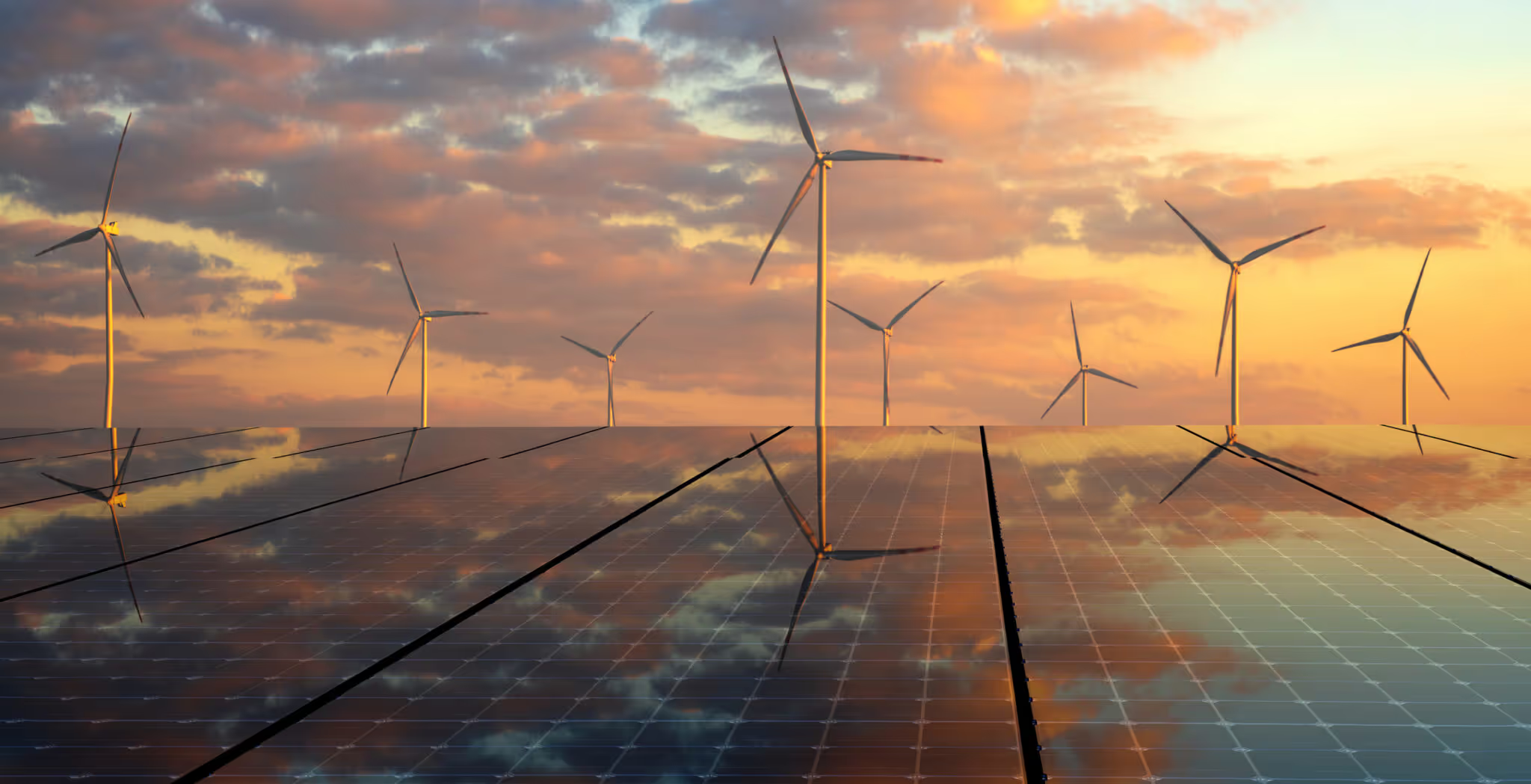
Brazil, Mexico, Chile, and Argentina also lead in developing solar photovoltaic and wind energy, and public-private investment in wind farms is growing throughout Latin America. In the future, it will be the region with the capacity to supply the world’s demand for hydrogen.

In hydroelectric power, one of the world’s largest dams is located on the border between Paraguay and Brazil. Others in South America already provide half of the electricity supply in their respective countries and hydroelectric projects have excellent growth prospects in the short term.

Along the same lines, Bioenergy is growing in importance. In the coming decade, South America will become a significant producer of hydrogen and low-cost, low-emission fuels, especially in Argentina, Brazil, Colombia, and Chile, where key projects have been announced.

Another aspect to highlight is the extraction of raw materials for sustainable energy alternatives. Chile and Argentina, together with Bolivia, are the second and fourth-largest lithium producers in the world, respectively. As for copper, Latin America accounts for 40% of world production, with significant extraction of other minerals such as graphite, nickel, and magnesium.

For investors interested in these markets, there are now national government regulations involving the public and private sectors and international cooperation agencies to invest in the economic and social development in México, Central and across South America.

Find here the 4 Energy trends that will shape LATAM in 2024

Conclusion

Latin America’s rich natural resources, growing renewable energy infrastructure, and commitment to sustainability position the region as a key player in the global green transition. With the right investments and policies, it has the potential to drive economic growth while leading the way toward a cleaner, more sustainable future.

Our Story

View All News
Public Affairs

Hungary’s April 2026 Elections: Why This Vote Matters for Policy and Business

Speyside Group analyzes Hungary’s 2026 parliamentary elections on 12 April. The elections represent a critical inflection point with direct implications for businesses and investors. Polls suggest a lead for the opposition Tisza party, but structural features of the electoral system and entrenched Fidesz influence mean policy change is likely to be gradual and uneven, creating ongoing regulatory and political uncertainty. The outcome will shape Hungary’s EU engagement, access to funding, sectoral policy, and geopolitical positioning, with implications for market access, fiscal stability, and operational risk. Companies should prioritize regulatory foresight, stakeholder engagement, and adaptable strategies to navigate a transitional environment where political shifts may not immediately translate into predictable policy outcomes.
Read post
Healthcare

The Global Price Anchor: Why 2026 is the Year of the "Glocal" Drug Strategy

Speyside Group analyzes the transformative "Great Healthcare Plan" of 2026, which has fundamentally redefined Pharmaceutical Market Access by linking U.S. drug pricing to international benchmarks. This shift toward a "glocal" strategy means that negotiation outcomes in Europe or APAC now act as a direct Global Price Anchor for the American market, effectively collapsing the divide between domestic and international pricing.
Read post
Public Affairs

Venezuela's Transition: Maduro's Capture, Legal Framework, and the Race for Strategic Resources.

The Speyside Latin America team analyzes the seismic shift in Venezuela following the U.S. military operation "Operation Absolute Resolve" and the arrest of Nicolás Maduro in January 2026. This event has triggered a Crisis management scenario, resulting in a transitional government under Delcy Rodríguez subject to direct U.S. oversight. With the world's largest proven oil reserves of 303 billion barrels and vast critical mineral deposits, Venezuela presents high-stakes opportunities for investors in high growth and emerging markets. Our analysis covers the immediate bullish reaction in the energy sector—with major gains for companies like Chevron and Halliburton—and the strategic race to secure assets in the Orinoco Mining Arc. Navigating this volatile landscape requires robust Corporate Affairs strategies to manage regulatory changes and complex stakeholder engagement.
Read post