Venezuela stands at a pivotal moment. International pressure has reached unprecedented levels, and the country's trajectory, whether toward political transition or prolonged instability, carries significant implications for businesses in the energy and extractive sectors.
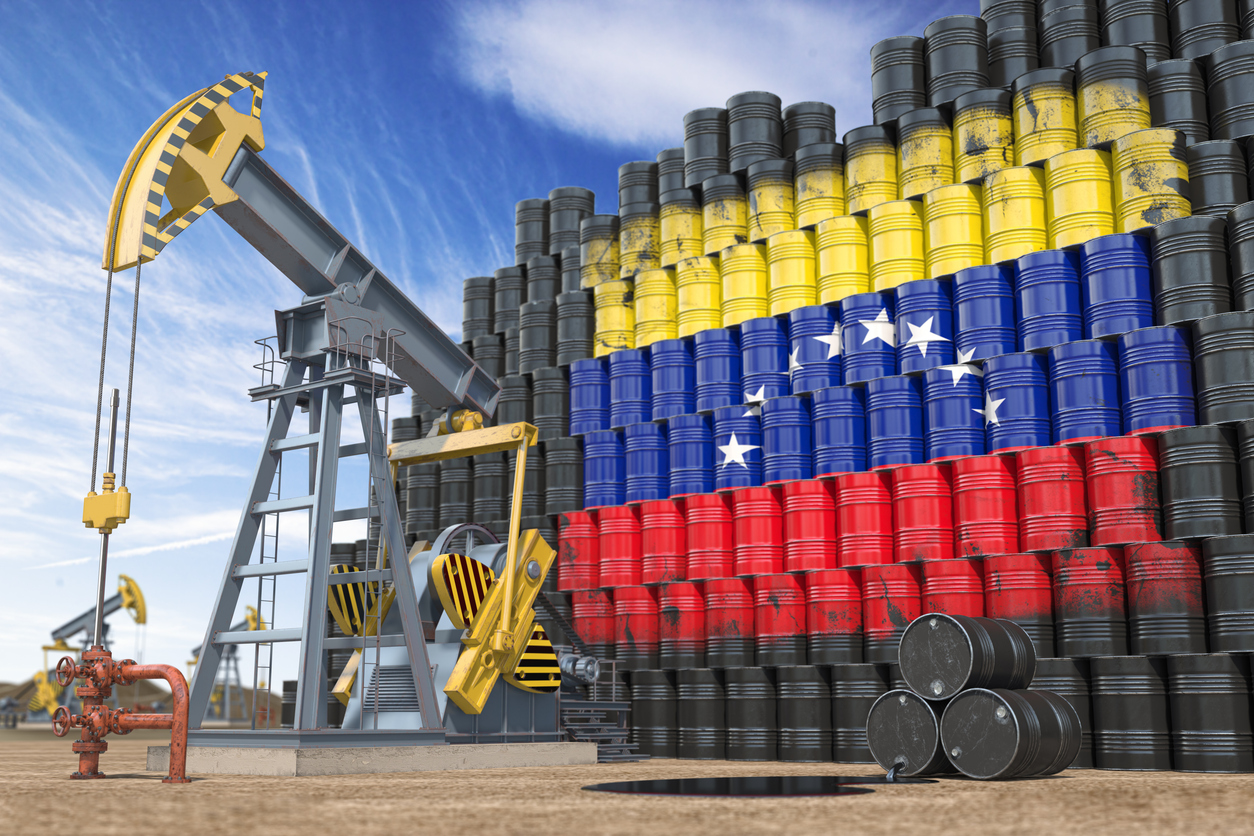
But one thing remains constant: Venezuela's resource endowment is unmatched. The country holds the world's largest proven crude oil reserves at 303 billion barrels, the seventh-largest natural gas reserves globally, and critical minerals including gold, coltan, bauxite, and rare earth elements. The question is not whether these resources will be developed, but under what terms, with what institutions, and with which investors. Consider that the window for strategic positioning is measured in months, not years. Companies that wait for full clarity will find themselves competing against those who prepared during uncertainty.
A Steep Economic Decline
Venezuela's economy has contracted by approximately 75% since 2013, representing one of the largest peacetime economic collapses in modern history. The International Monetary Fund projects inflation at roughly 270% for 2025 and over 600% for 2026—the highest in the world. Oil production has fallen from over 3 million barrels per day in the early 2000s to approximately 900,000 barrels per day today, with exports further constrained by US sanctions and price discounts of 10-20% for sales to China. Nearly 8 million Venezuelans (roughly a quarter of the population) have emigrated since 2014.
The collapse has also opened an unusual opportunity. The Venezuelan opposition led by Edmundo González Urrutia (recognized by the United States as the legitimate winner of the 2024 presidential election) and María Corina Machado (recipient of the 2025 Nobel Peace Prize) has presented a USD 1.7 trillion economic transformation framework focused on privatization, foreign investment and the restructuring of Petróleos de Venezuela (PDVSA), the state oil company.
International financial institutions have taken notice, too. UBS's Chief Investment Office released a memo in October 2025 titled “Visualizing the Day After Tomorrow,” describing Venezuela as "a land of opportunity" with a "severely underutilized economy." Investment banks including Barclays have held private discussions between institutional investors and opposition leadership on post-transition considerations.
Why Maduro Has Ruled for 12 Years
Why Nicolás Maduro remains in power, even though the economy has crashed, mass emigration is going high and there has been significant external pressure to change the governing style, is key to analysing how likely each of these political scenarios is. The answer has less to do with domestic support than with an array of external backers:
China has supplied Venezuela with nearly USD 50-60 billion in loans since 2007, mainly through oil-for-loan deals to guarantee energy supplies and support the Maduro government. Even when Beijing suspended new lending around 2016 in response to payment problems, China remains Venezuela’s largest oil customer, with the country funneling its Venezuelan crude through intermediaries in defiance of US sanctions. Venezuela owes China roughly USD 10-16 billion.
Russia has further deepened military cooperation in recent years, providing S-300 air defense systems, Sukhoi fighter jets and new Pantsir-S1 and Buk-M2E missile batteries has been reported. One Russian general is said to lead an advisory mission in Venezuela, and a Russian cargo plane banned by the US for sending defense equipment made landfall in the country late in October 2025. But Russia’s commitment has bounds. Foreign Minister Sergey Lavrov recently said in a speech in November 2025 that Venezuela “hasn’t come to us” for military assistance, and analysts say Moscow, crippled by the war in Ukraine, does not have the resources to intervene significantly.
Cuba offers something arguably more important than weapons: intelligence infrastructure. Cuban advisers since 2008 have done much to restructure Venezuela’s military counterintelligence services, which have been cast into monitoring its internal dissidents but are now not a tool with external threat. There are around 5,000-6,000 Cuban personnel operating in Venezuelan ministries, military installations and intelligence agencies, who bring expertise in surveillance, repression and regime protection. This Cuban participation has been credited by the Maduro government with allowing it to counter military coups and coordinate internal security.
The key insight for businesses: Maduro’s survival depends more on the continuing calculation by Beijing, Moscow and Havana that standing up for him is still worth paying a price. A change in that calculus, especially if it comes from China, would change the probability distribution of political scenarios fundamentally.
The US Pressure Campaign—and Its Limits
The Trump administration has increased pressure on Venezuela to levels not seen since the Cold War. Operation Southern Spear has placed the U.S. military in the Caribbean at its largest level for decades; since September 2025, the U.S. forces have carried out more than 21 strikes against suspected drug-trafficking vessels, with a count of at least 83 deaths. But there exists an essential caveat that businesses need to include in their scenario planning: the Trump administration has lacked authorization granted by Congress for military action against Venezuela.
The War Powers Resolution of 1973 requires the President to notify Congress within 48 hours of committing military forces, and mandates either approval within the legislature or withdrawal within 60 days. Neither condition has been met. That 60-day deadline expired in November 2025, which means the administration is no longer abiding by the statute that defines presidential war-making authority.
Moreover, congressional opposition is bipartisan. Senators Tim Kaine (D-VA), Chuck Schumer (D-NY), Adam Schiff (D-CA), and Rand Paul (R-KY) filed a War Powers Resolution on Dec. 3-4, 2025, aimed to stop American military actions from continuing without congressional approval. Senator Kaine wrote: “The Constitution grants Congress—and only Congress—the authority to declare war.” Senator Paul, too: “The American people do not want to be dragged into endless war with Venezuela without public debate or a vote.”
According to UN human rights specialists, US strikes violate Article 2(4) of the UN Charter, which prohibits threats or use of force against the territory of another state. According to legal analysis from the Perry World House at the University of Pennsylvania, the operations have been unlawful
both under jus ad bellum (law governing resort to force) and jus in bello (law governing conduct in hostilities). As time goes on, this legal exposure makes a full-scale military intervention harder to defend and less likely to occur.
The implication for scenario planning: No congressional authorization for a full-scale military intervention remains a legal and political constraint. This pushes the most likely direction away from abrupt regime change (Scenario 3) and towards one of either negotiated transition (Scenario 2) or stalemate, albeit an incredibly long stalemate (Scenario 1). See below for those scenarios.
Three Scenarios: Connected by One Variable
The following scenarios are not independent. They’re associated pathways formed by an important factor: whether Venezuela’s military gauges that it is worth the expense in defending Maduro.
Scenario 1: Political Continuity with Pragmatic Adaptation
Probability: 30-40%
In this case, in which both the Maduro government and his allies are united in arms, and continues the support from China, Russia and Cuba. Pragmatic economic desperation leads to liberal investment opportunities from abroad, provided, they are within a regime-insure framework. This is not hypothetical. It is already happening. PDVSA recently entered into nine production-sharing agreements with Chinese and Argentine companies after Chevron's license expired in 2025, allocating operational rights on blocks in Zulia state and the Orinoco Belt while maintaining at least 50% state ownership. Anhui Guangda Mining Investment, a private Chinese company, became the first foreign company to produce crude in Venezuela under a 20-year concession (an arrangement previously unavailable). PDVSA estimates the investment at USD 20 billion, generating 600,000 barrels per day under such arrangements.
Scenario 2: Negotiated Transition via Internal Fracture
Probability: 40-50%
The case is that the military, facing credible external threats, internal divisions, or a shift in Chinese/Russian support, allows Maduro to get out of the crisis through negotiation. This might mean a military junta taking over with transition commitments and transitional responsibilities or a direct handover to opposition leadership with amnesty provisions for regime officials.
The opposition’s economic architecture would then be put into action: Venezuelan oil and gas fields, refineries, and midstream assets opened to competitive foreign bidding; PDVSA restructured with a diminished degree of state control; international investment protections folded into Venezuelan law; production targets above 3 million barrels per day (a milestone not achieved in 15 years). That said, keep in mind that it would take 6-12 months to consolidate the transition government. Major concession processes would probably start 12-24 months after the transition. Global firms are monitoring for any public signal from Beijing about debt restructuring or lessened aid or unusual military personnel changes in Venezuela.
Scenario 3: Forced Regime Change via Military Intervention
Probability: 15-25%
In this scenario, diplomatic and economic pressure would not end the regime transition, and the Trump administration authorizes targeted military operations against regime leadership and infrastructure. The US Congress has attempted to block it, Russia could deploy air defense forces, and conflicts would continue to be long in length, which means that this line of development is not within the faintest expectation. Though analysts find that Russia has no ability to carry out direct military intervention, the presence of Russian advisers makes any military action all the more crucial given U.S.-Russian tensions over Ukraine.
Also, a broad bloc of countries has widely condemned foreign intervention in Venezuela. Colombia, Mexico, and Cuba signed a joint statement rejecting the U.S. military buildup in Caribbean waters. Iran’s Foreign Minister called the US campaign “aggressive unilateralism” and a violation of the UN Charter. Inside the United States, a CBS News/YouGov poll found that 70% of Americans oppose military action in Venezuela, and 76% said the Trump administration has not outlined its intentions clearly. Such international and domestic opposition, alongside the administration’s concurrent threats to intervene in Nigeria over allegations of persecution of Christians, narrows US credibility and bandwidth and constrains an even higher probability of action in Venezuela.
Resources and Legal Frameworks: What You Need to Know
Oil and Gas
Venezuela's hydrocarbons sector operates in a framework that requires state majority ownership. The 2001 Hydrocarbons Law requires PDVSA to have a 50% stake or more of joint ventures, with foreign partners to a limited degree. But the “Anti-Blockage Law” of 2020 modified these rules and may allow foreign companies to run or outright own operations.
And yet US sanctions remain the main barrier to entry. OFAC proscribes US persons from transactions with PDVSA. There are a few exceptions: the US Treasury granted a three-phase license for the Dragon offshore gas project involving Shell and Trinidad in October 2025, allowing for negotiations up to April 2026 but requiring U.S company involvement.
And for non-US companies, the picture is more nuanced. European, Asian, and Latin American businesses, meanwhile, are not subject directly to OFAC restrictions, but they are not immune to them either. The risk of secondary sanctions remains significant for companies that engage in substantial transactions with PDVSA or Venezuelan government entities. These firms could find themselves cut off from the US financial system, lose access to dollar-denominated transactions, or face asset freezes on any US-held property. The March 2025 executive order authorizing “secondary tariffs” on imports from countries purchasing Venezuelan oil raised the stakes further, signaling Washington’s willingness to penalize third-country actors.
Mining
The Orinoco Mining Arc, 112,000 square kilometers leased for extraction, contains government-estimated reserves of 7,000 tons of gold, large coltan deposits, and rare earth elements, but these quantities have not been independently verified. It allows joint ventures, which should also be limited to at least 55% government ownership.
In real terms, the mining sector largely operates outside of formal structures. Armed groups such as Colombia's ELN and FARC dissidents exert power over extensive territory, and International Crisis Group research reveals that army generals are paid bribes averaging USD 800,000 a month. Any transition that opens the door for formal mining is conditional on forced displacements of armed groups, military transformation, and transparent concession regimes—a process that would take years.
Natural Gas
Two offshore projects represent near-term development opportunities: the Perla Field (Repsol/ENI, producing 550 million cubic feet per day with expansion potential to 1.2 billion) and the Dragon Field (4.2 trillion cubic feet in reserves, Shell-led development targeting 2026 production with US license authorization).
Three Takeaways
Transition is more likely than intervention. There is ample evidence of the fact that negotiated transition planning (Scenario 2) is the preferred road to large market opportunities.
Watch China and Russia. Maduro’s survival depends on outside backers. A change in Chinese debt posture or an uplift in Russian military investment would drastically speed up transition chances. These are leading indicators.
Just as the first-mover advantage is real, so is reputational risk. Companies that invest in assessing political risk, forming legal frameworks, and relationship management in such uncertain times will find they will gain outsized value. However, premature public positioning exposes organizations to sanctions and stakeholder scrutiny.
How Speyside Can Help
Speyside Group maintains deep institutional knowledge of Venezuelan political, energy, and mining landscapes. For companies evaluating Venezuelan exposure, whether through scenario planning, sanctions compliance advisory, commercial due diligence, or stakeholder mapping, our team is positioned to support strategic decision-making ahead of a potential transition.
In a market as opaque and volatile as Venezuela, successful entry—or re-entry—is not just about capital; it is about information asymmetry and regulatory foresight. Speyside supports energy and mining companies in three specific areas:
1. Market Intelligence & Scenario Planning: We go beyond headlines to track the specific indicators that signal a shift in Venezuela’s trajectory, from changes in PDVSA’s operational leadership to shifts in Chinese debt restructuring. We provide clients with granular, localized intelligence on how political scenarios (continuity vs. transition) will impact specific concessions, asset integrity, and competitive dynamics.
2. Stakeholder & License to Operate Analysis: Whether operating under the current administration or preparing for a future one, understanding the stakeholder map is critical. We help clients identify and assess the key influencers—community leaders, local authorities, industry associations, and labor unions—whose alignment will be necessary to secure and maintain a social license to operate. For mining specifically, we analyze the complex security environment to help companies understand the true operational risks beyond the legal concessions.
3. Regulatory & Sanctions Navigation: We collaborate with legal advisors to help companies interpret the commercial implications of OFAC regulations, secondary sanctions risks, the evolving Venezuelan legal frameworks (like the Anti-Blockage Law), and the shifting landscapes as they develop. We assist with charting compliant entry strategies that strike a balance between first-mover advantage and rigorous risk management.
The Bottom Line: The window for strategic positioning is measured in months, not years. Speyside Group has guided multinational energy and mining companies through political transitions and regulatory upheavals across Latin America. Companies investing in understanding the landscape today, capitalizing on established regional expertise, will be the ones to move when the opportunity fully materializes.
References
1. OPEC. Annual Statistical Bulletin 2024. Vienna: Organization of the Petroleum Exporting Countries, 2024.
2. U.S. Energy Information Administration. "Country Analysis: Venezuela." Washington, D.C.: EIA, 2024. https://www.eia.gov/international/analysis/country/VEN
3. Council on Foreign Relations. "Venezuela: The Rise and Fall of a Petrostate." CFR Backgrounder, January 2021. https://www.cfr.org/backgrounder/venezuela-crisis
4. International Monetary Fund. World Economic Outlook Database. October 2025. https://www.imf.org/en/Publications/WEO
5. CNN. "Amid tensions with US, high inflation is back on Venezuela's radar." November 11, 2025. https://www.cnn.com/2025/11/11/americas/venezuela-inflation-us-tension-intl-latam
6. Human Rights Watch. World Report 2025: Venezuela. January 2025. https://www.hrw.org/world-report/2025/country-chapters/venezuela
7. Americas Quarterly. "The Future of Venezuela's Diaspora." July 8, 2025. https://www.americasquarterly.org/article/the-future-of-venezuelas-diaspora/
8. CNN. "US recognizes Venezuelan opposition leader Edmundo González as 'president-elect' of Venezuela." November 19, 2024. https://www.cnn.com/2024/11/19/americas/venezuela-gonzalez-president-elect-intl-latam
9. DW. "EE.UU. califica de 'presidente legítimo' a González Urrutia." January 22, 2025. https://www.dw.com/es/eeuu-califica-de-presidente-leg%C3%ADtimo-a-gonz%C3%A1lez-urrutia/a-71378306
10. Nobel Prize Committee. "The Nobel Peace Prize 2025: Maria Corina Machado." October 10, 2025. https://www.nobelprize.org/prizes/peace/2025/machado/facts/
11. BBC. "Venezuelan opposition leader wins Nobel Peace Prize." October 10, 2025. https://www.bbc.com/news/articles/c70821201ego
12. Fortune. "Nobel Prize winner says Venezuela has a 'unique' $1.7 trillion opportunity to privatize after socialism disaster." October 27, 2025. https://fortune.com/2025/10/27/nobel-prize-winner-venezuela-1-7-trillion-privatization-machado-socialism-disaster/
13. UBS Chief Investment Office. "Visualizing the Day After Tomorrow." Wealth Management Research Memo, October 2025. https://www.ubs.com/global/es/wealthmanagement/latamaccess/market-updates/articles/venezuela-path-after-chavismo.html
14. Semafor. "As Trump pressures Venezuela, investors see 'major opportunities.'" November 3, 2025. https://www.semafor.com/article/11/03/2025/as-trump-pressures-venezuela-investors-see-major-opportunities
15. Council on Foreign Relations. "China's Growing Influence in Latin America." April 2022. https://www.cfr.org/backgrounder/china-influence-latin-america-argentina-brazil-venezuela-security-energy-bri
16. Reuters. "China's oil trade and investment in Venezuela." September 12, 2023. https://www.reuters.com/business/energy/chinas-oil-trade-investment-venezuela-2023-09-12/
17. Princeton School of Public and International Affairs. "PSFL Policy Brief 25-1." April 2025. https://psfl.princeton.edu/document/306
18. Lansing Institute. "Russian Air-Defense Deliveries to Venezuela and the Escalation Risk of U.S.-Venezuela Military Conflict." November 5, 2025. https://lansinginstitute.org/2025/11/05/russian-air-defense-deliveries-to-venezuela-and-the-escalation-risk-of-u-s-venezuela-military-conflict/
19. Business Insider. "Senior Russian Lawmaker Says Moscow Sent New Air Defenses to Venezuela." November 3, 2025. https://www.businessinsider.com/russian-lawmaker-send-pantsir-buk-venezuela-air-defenses-ilyushin-2025-11
20. The War Zone. "Russian General In Venezuela Leading Advisory Mission: Ukraine's Intel Chief." November 18, 2025. https://www.twz.com/news-features/russian-general-in-venezuela-leading-advisory-mission-ukraines-intel-chief
21. TASS. "Venezuela never turned to Russia for military aid — Lavrov." November 10, 2025. https://tass.com/politics/2042117
22. The Moscow Times. "Moscow Risks Losing a Key Ally in Latin America as Trump Ramps Up Pressure on Venezuela." November 13, 2025. https://www.themoscowtimes.com/2025/11/13/moscow-risks-losing-a-key-ally-in-latin-america-as-trump-ramps-up-pressure-on-venezuela
23. Reuters. "Special Report: How Cuba taught Venezuela to quash military dissent." August 21, 2019. https://www.reuters.com/article/world/special-report-how-cuba-taught-venezuela-to-quash-military-dissent-idUSKCN1VC1BU/
24. Havana Times. "The Footprints of Cuban Intelligence in Venezuela." August 14, 2024. https://havanatimes.org/features/the-footprints-of-cuban-intelligence-in-venezuela/
25. The Hill. "Democrats unveil Venezuela war powers resolution." December 4, 2025. https://thehill.com/homenews/senate/5632671-trump-venezuela-military-resolution/
26. Reuters. "US lawmakers want war powers vote after Trump pledges Venezuela attack 'soon.'" December 3, 2025. https://www.reuters.com/world/us/us-lawmakers-want-war-powers-vote-after-trump-pledges-venezuela-attack-soon-2025-12-03/
27. Senator Tim Kaine. "Kaine, Paul, Schumer, & Schiff File War Powers Resolution on Venezuela." Press Release, December 2, 2025. https://www.kaine.senate.gov/press-releases/kaine-paul-schumer-and-schiff-file-war-powers-resolution-on-venezuela
28. CBS News. "Trump's Venezuela boat strikes fuel war crimes allegations. Are they legal?" December 3, 2025. https://www.cbsnews.com/news/trump-hegseth-venezuela-boat-strikes-war-crimes-are-they-legal/
29. Fox News. "Rand Paul joins Dems on 'war powers resolution' claiming Trump admin could soon strike Venezuelan territory." December 4, 2025. https://www.foxnews.com/politics/rand-paul-joins-dems-war-powers-resolution-claiming-trumo-admin-could-soon-strike-venezuelan-territory
30. Common Dreams. "Congressmen Unveil Bipartisan War Powers Resolution to Restrict Trump on Venezuela." December 3, 2025. https://www.commondreams.org/news/war-powers-act-trump
31. UN Office of the High Commissioner for Human Rights. "UN experts condemn coercive intervention in Venezuela by United States." October 20, 2025. https://www.ohchr.org/en/press-releases/2025/10/un-experts-condemn-coercive-intervention-venezuela-united-states
32. Perry World House, University of Pennsylvania. "Q&A with William Burke-White: Understanding the Legal Ramifications of US Attacks on Venezuela." November 10, 2025. https://perryworldhouse.upenn.edu/news-and-insight/perry-world-house-qa-with-william-burke-white-understanding-the-legal-ramifications-of-us-attacks-on-venezuela/
33. Offshore Technology. "Venezuela signs nine oil deals." June 5, 2025. https://www.offshore-technology.com/news/venezuela-signs-nine-oil-deals/
34. Reuters. "Private Chinese firm producing oil in Venezuela under rare 20-year pact." August 22, 2025. https://www.reuters.com/business/energy/private-chinese-firm-producing-oil-venezuela-under-rare-20-year-pact-source-says-2025-08-22/
35. Reuters. "CERAWEEK: Venezuela's opposition drafts energy reform to raise foreign pressure." March 12, 2025. https://www.reuters.com/business/energy/ceraweek-venezuelas-opposition-drafts-energy-reform-raise-foreign-pressure-2025-03-12/
36. Anadolu Agency. "Venezuela open to foreign investment in oil sector." January 14, 2021. https://www.aa.com.tr/en/energy/invesments/venezuela-open-to-foreign-investment-in-oil-sector/31601
37. U.S. Department of the Treasury, OFAC. "Venezuela-Related Sanctions." https://ofac.treasury.gov/sanctions-programs-and-country-information/venezuela-related-sanctions
38. Reuters. "US grants license for Shell, Trinidad to develop Venezuelan gas field." October 9, 2025. https://www.reuters.com/business/energy/us-grants-license-shell-trinidad-develop-venezuelan-gas-field-official-says-2025-10-09/
39. International Crisis Group. "A Curse of Gold: Mining and Violence in Venezuela's South." July 29, 2025. https://www.crisisgroup.org/latin-america-caribbean/andes/venezuela/b53-curse-gold-mining-and-violence-venezuelas-south
40. Offshore Technology. "Perla Field, Venezuela." Project Profile. https://www.offshore-technology.com/projects/perla-field/
41. Anadolu Agency. "Majority of Americans oppose US military action in Venezuela: Poll." November 23, 2025. https://www.aa.com.tr/en/americas/majority-of-americans-oppose-us-military-action-in-venezuela-poll/3752108
42. Deutsche Welle. "Trump says there 'could be' US military action in Nigeria." November 2, 2025. https://www.dw.com/en/trump-says-there-could-be-us-military-action-in-nigeria/a-74592286
43. Atlantic Council. "With Trump’s threats of military intervention in Nigeria, Tinubu faces a delicate balancing act." November 4, 2025. https://www.atlanticcouncil.org/blogs/new-atlanticist/with-trumps-threats-of-military-intervention-in-nigeria-tinubu-faces-a-delicate-balancing-act/
44. UN Office of the High Commissioner for Human Rights. "UN experts alarmed by United States escalating pressure on Venezuela." December 4, 2025. https://www.ohchr.org/en/press-releases/2025/12/un-experts-alarmed-united-states-escalating-pressure-venezuela
Conclusion
Venezuela stands at a pivotal moment where unmatched resource endowment clashes with severe economic decline and political uncertainty. While the economic collapse has created a unique opening for opposition-led transformation frameworks, President Maduro's survival remains tethered to external support from China, Russia, and Cuba.
For businesses, the key takeaway is that a negotiated transition is more probable than military intervention, and the window for strategic positioning is measured in months, requiring proactive intelligence gathering rather than waiting for full clarity.